Design powered geo holdouts and read true channel lift
Pick markets, check power before spend, run a geo holdout, and compare multiple counterfactual models with intervals. Measure TV, CTV, social, search, direct mail, or any channel you can target by geography.
Design, launch, analyze, and export every geo test in one workspace. Results become evidence for MMM and your AI MCP/API context layer.
Power checked first
See the minimum detectable lift and budget required before a campaign launches.
Models compared
Run regression, synthetic control, ASCM, SDID, and BSTS side by side.
Intervals shown
Lift, iCAC, and iROAS include uncertainty ranges instead of a single point estimate.
AI/API ready
Published designs and results become read-only context for MCP, the API, and MMM calibration.
Everything a geo test needs, in one tool
From sizing and market selection to multi-model results and MMM calibration. You bring the channel and the data. We do the math.
Sized before you spend
Built-in power analysis shows the smallest lift you can reliably detect, so you launch a test that can actually win instead of wasting budget.
A holdout you can trust
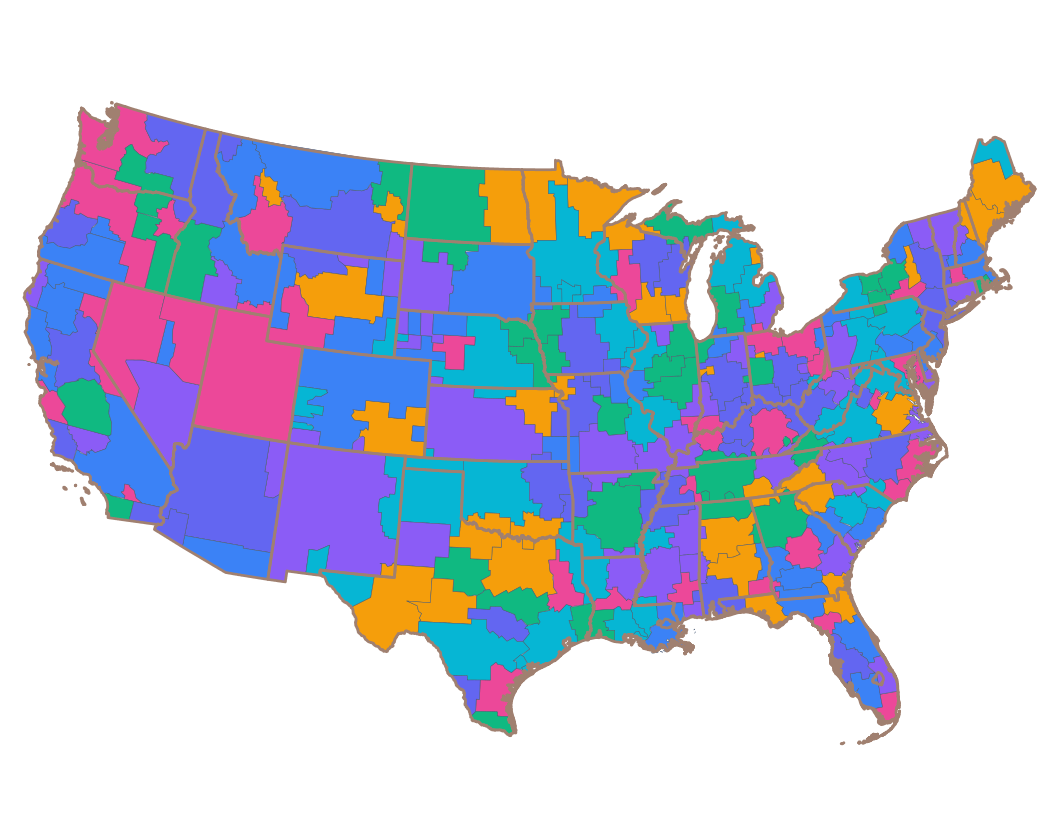
A purpose-built design engine finds the cleanest treatment and control split for you: balanced, comparable markets, not a coin flip.
Many models, one view
Run several independent counterfactual models and compare them side by side. We never quietly cherry-pick the flattering one.
Honest uncertainty
Every counterfactual-derived metric comes with a confidence range, giving you a clear read on how sure you can be without false precision.
One central record
Every design, run, and result is stored by brand: searchable, auditable, and ready to reference the next time you plan.
Feeds your MMM
Each geo result becomes causal ground truth that calibrates and validates your media mix model down the line.
From markets to a measured lift, all point-and-click
Four steps, no spreadsheets, nothing to wire up. You stay in control at every decision.
Choose your markets
Pick the channel and geography. The app recommends a balanced treatment and holdout split, or you select your own markets.
Design the test
Set duration and budget, run the power analysis, and see the lift you can detect before a single dollar is spent.
Launch & collect
Run the campaign in your treatment markets. When the test wraps, upload your results with no tags or integrations required.
Read the lift & decide
Get incremental lift, CAC or ROAS, and uncertainty across every model. You make the call, with the full picture in front of you.
What incrementality actually looks like
Treatment and holdout markets move together until launch. The gap that opens up afterward, plus how confident we are in it, is your incremental lift.
Treatment vs holdout
The gap between treatment and a statistically built holdout is your true incremental lift — reported with an uncertainty range, not a single guess.
Balanced and powerful. Most tools make you choose.
A geo test lives or dies on its design, and the design is genuinely hard. You want treatment and control groups that look alike, and a test with enough power to detect the lift. Push on one and you usually lose the other. Our design engine is built to win both at once, and it's one of the biggest reasons our tests read cleaner than the rest.
Perfectly balanced cells
We split your historical sales to hit the exact target share in every cell, so your groups are representative and truly comparable, the foundation of a clean causal read.
Maximum statistical power
At the same time, we maximize the test's power to detect real lift, so you can measure smaller effects with less spend and less time on test.
Any split that adds up to 100%
50/50, 80/20, 75/25, 33/33/33, 25/25/25/25: design two cells or many. If the splits sum to 100%, you can run it.
Run any split that adds to 100%
Historical sales, matched to your target split
One answer is a guess. Several is a decision.
Pick one counterfactual model or run them all, then compare every result. We show each model run and the uncertainty around it, so you can stress-test your read instead of trusting a black box.
Multi-model validation
Run one model or run them all, then compare side by side to stress-test your lift estimate.
Full transparency
No hidden models, no cherry-picked outputs. Every run is visible so you understand what each approach implies.
Uncertainty intervals
See wide and narrow ranges for every metric that uses the counterfactual baseline, not just the baseline itself.
Supported experimental designs
Flexible configuration for whatever question you need to answer.
Geo holdout (exclusion)
Suppress a channel in a set of markets to measure its incremental contribution.
Multi-cell interaction
Factorial designs that measure interaction effects between multiple channels or tactics.
Scale & spend tests
Model the response curve by testing different spend levels across comparable regions.
Incrementality measurement
Pure lift measurement for channels with poor attribution visibility, like TV and OOH.
Test any channel you can target by geography
If you can control spend or delivery by region, you can measure it and store every result to build your calibration library.
Built for everyone on the team
You don't need to be a statistician. The hard math runs under the hood; you point, click, and make the call with the full picture in front of you.
One framework. Every method talks to the others.
Geo, user-level, and platform tests all feed one central database. That shared truth calibrates and validates your MMM, while attribution keeps everything pointed in the right direction. Run any piece on its own — or run them together and let each one make the others stronger.
Inform. Attribution gives the MMM a fast, directional read on what's working between tests.
Calibrate. Incrementality tests anchor the MMM to causal ground truth, not just correlation.
Validate. Holdout tests check that attribution and the model agree with what really happened.
Every test in one workspace
Design, run, and analyze all your geo tests in one place, with everything stored in one database for whenever you need them next.

See a geo test move from setup to readout
The speedrun belongs here: it shows the concrete geo workflow behind the AI Scientist story, from uploaded data to design, diagnostics, and results.
Short speedrun preview of the geo incrementality workflow.
Geo incrementality testing FAQ
Measurement Ops Make the Product Repeatable
The models and tests matter, but the workflow around them matters too. Shako Stats is designed to become the operating system around experiment planning, metadata, documentation, and cross-test learning.
Data Management
Centralize datasets, mappings, and historical records so experiments and models always start from the same source of truth.
Tags and Parameters
Organize tests by audience, creative strategy, bidding logic, or business objective so learnings remain searchable and reusable.
Gantt Timeline
See what tests are planned, in-flight, or completed so overlapping interventions and measurement conflicts are easier to manage.
Documentation
Turn methodology, definitions, and experiment design guidance into an internal operating system instead of leaving them scattered across decks.
Or just ask your AI.
Connect any AI agent through MCP/API to a read-only context layer over your geo designs, power checks, lift results, iCAC/iROAS, confidence intervals, and model agreement. The deterministic statistical models still run in Shako Stats; the AI helps your team understand and reuse the evidence.
Meet your AI Marketing ScientistOne-click OAuth for Claude & ChatGPT, read-only, anyone on the team can ask
Bring rigorous measurement to your team
Design tests, understand results, and connect your team to one statistics-backed measurement workspace.
Built for brands & agencies.